Originally published on July 7, 2025 by Vital Physiotherapy & Wellness, now part of the Bravella Health network. Original author: Ysé Gerbaux.
Pregnancy is such a transformative time. It’s filled with anticipation, hope, and sometimes, unexpected challenges. One of those challenges can be finding out in your third trimester that your baby is in a breech position, meaning their head is positioned up towards your ribs, rather than in the head down position that is optimal for birth.
If your baby is currently in a breech position, it’s helpful to know that some babies turn on their own, others may need a little help, and there are gentle, natural options available. Acupuncture and moxibustion are two time-honored therapies that may offer support in helping your baby shift into a head-down position.
Let’s walk through what breech presentation means, how these therapies work, and what current research says, so you feel informed, empowered, and never alone in this journey.
What Is a Breech Presentation?
A breech presentation means your baby’s bottom or feet are positioned to be birthed first, instead of their head. Breech presentation is more common than many people realize, with about 3 to 4% of pregnancies affected at term.[1] Breech babies may still turn naturally, but when they don’t, healthcare providers may consider techniques like External Cephalic Version (ECV) or cesarean delivery.[1]
There are a few types of breech positions. Frank breech is when your baby’s legs are extended straight up toward their head. Complete breech is when the legs are bent with feet close to their bottom. Footling breech is when one or both feet are positioned to come out first.
What Are Acupuncture and Moxibustion?
Acupuncture and moxibustion are traditional Chinese medicine practices that have been used for thousands of years to support the body’s natural balance. At their core, these therapies are gentle, nurturing, and rooted in the belief that your body is wise and capable.
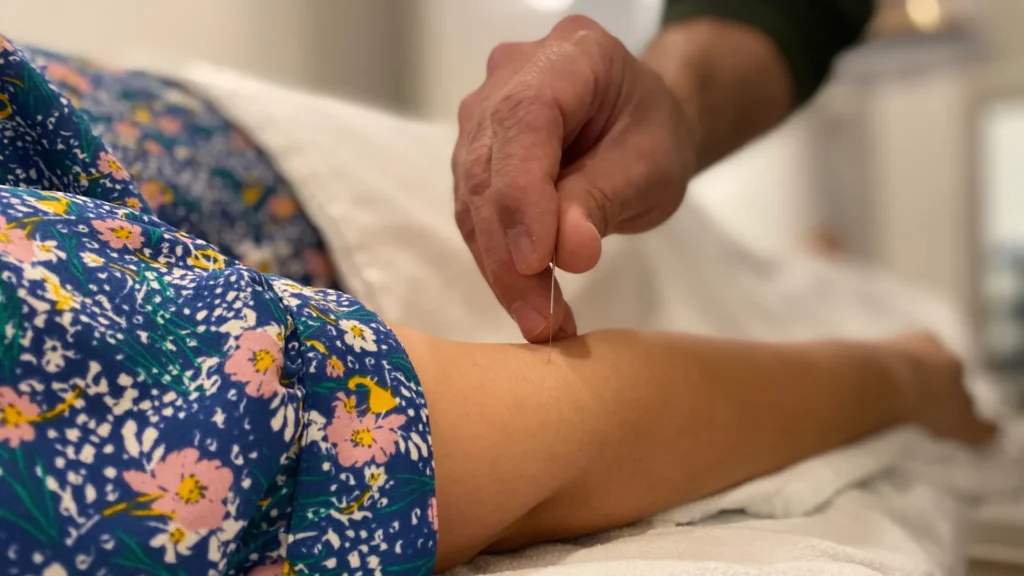
Acupuncture involves the use of tiny, sterile needles at specific points on the body to support energy flow and hormonal balance. Moxibustion uses heat from burning dried mugwort, a healing herb, applied near these same points, particularly one near the pinky toe called BL67.[2]
Both therapies are considered safe during pregnancy when done by a qualified practitioner who has experience working with pregnant people.[2,5]
How Can These Therapies Help with Breech Babies?
While the exact reason these therapies work isn’t fully understood in Western medicine, the theory is that stimulating specific acupuncture points like BL67 can encourage uterine activity, hormonal release such as prostaglandins and estrogen, and baby movement.[2] The warmth and stimulation may help create the conditions your baby needs to gently find their way into a head-down position.
These therapies are usually started around 33 to 36 weeks for best results.[2]
What Does the Research Say?
The research is promising.
There’s growing evidence that acupuncture and moxibustion (a gentle warming technique) can help encourage babies to turn head-down. One review looked at over 2,500 people and found a higher chance of turning when moxibustion was used. While more research would be great, what we’ve seen so far is hopeful.[3]
In another study, more than half of the pregnant participants who received moxibustion at a specific acupuncture point (called BL67) had babies who turned, compared to less than half in the other groups.[4]
A Cochrane review found that moxibustion may reduce the need for ECV, though the authors noted that more high-quality trials are needed.[5]
Of course, timing and expert support matter. If you’re curious whether this approach could work for you, it’s worth having a conversation with your care provider.
Is It Safe?
Yes, when done by someone trained in prenatal care. Acupuncture and moxibustion are safe when performed by a licensed practitioner who understands how to work with pregnant bodies. They’ll know which points to use and which ones to avoid to keep you and your baby safe.
Other Supportive Options for Breech Babies
In addition to acupuncture and moxibustion, you may want to explore options like External Cephalic Version (ECV), a medical technique where a provider gently turns the baby from the outside.[1] You can also look into Spinning Babies techniques, which include specific stretches and positions to encourage optimal fetal positioning. Relaxation and visualization exercises can also help reduce stress and support your body’s natural rhythm.
A Final Word from Someone Who Cares
If your baby is breech and you’re feeling uncertain, overwhelmed, or just a little emotional, that’s okay. You’re doing everything right. There are caring, knowledgeable providers who want to help you feel more at ease and supported in your choices.
Acupuncture and moxibustion are gentle tools that honor both ancient wisdom and modern needs. They may offer just the nudge your baby needs, and they always offer you something important: care, calm, and connection to your body.
Book your appointment with our Registered Acupuncturist today!
References
- Hofmeyr GJ, Kulier R, West HM. External cephalic version for breech presentation at term. Cochrane Database Syst Rev. 2015;(4):CD000083. doi:10.1002/14651858.CD000083.pub3
- Schlaeger JM, Stoffel CL, Bussell JL, et al. Moxibustion for cephalic version of breech presentation. J Midwifery Womens Health. 2018;63(3):309-322. doi:10.1111/jmwh.12752
- Liao JA, Shao SC, Chang CT, et al. Correction of breech presentation with moxibustion and acupuncture: a systematic review and meta-analysis. Healthcare (Basel). 2021;9(6):619. doi:10.3390/healthcare9060619
- Vas J, Aranda-Regules JM, Modesto M, et al. Using moxibustion in primary healthcare to correct non-vertex presentation: a multicentre randomised controlled trial. Acupunct Med. 2013;31(1):31-38. doi:10.1136/acupmed-2012-010261
- Coyle ME, Smith CA, Peat B. Cephalic version by moxibustion for breech presentation. Cochrane Database Syst Rev. 2012;(5):CD003928. doi:10.1002/14651858.CD003928.pub3